

 Let's Talk






Key Takeaways:
- Base salary is only one part of the cost of hiring an employee.
- Employer contributions, benefits, insurance, recruitment, and other expenses can add significantly to the total cost.
- Offshore staffing can give businesses access to experienced professionals at a lower overall employment cost.
- Filta’s 2026 Salary Guide includes salary ranges and True Total Cost calculations for roles in the Philippines and Colombia.
- The best comparison looks at the full cost of employment and the role the person will play in the business.
Bottom line:
Offshore staffing can cost significantly less than a local hire, but salary alone does not tell you how much a new employee will actually cost. Looking at the full employment cost gives you a more useful comparison.
When comparing offshore staffing with a local hire, it is easy to start with salary.
A company might see a $70,000 local salary and compare it with a $30,000 offshore salary. But neither figure tells the full story. Employers also have to account for benefits, government contributions, insurance, recruitment, equipment, and other employment costs.
That is where the difference becomes clearer.
What Goes Into the Cost of a Local Hire?
A local employee costs more than their annual salary.
Depending on the country and employment arrangement, businesses may also pay for employer taxes and contributions, health insurance, paid leave, recruitment, equipment, office space, and other benefits.
These costs can vary considerably by market, which is why comparing salary alone can give you an incomplete picture.
The same applies to offshore hiring. A lower salary does not automatically mean a lower total cost unless the other employment expenses are included.
What Does Offshore Staffing Cost in 2026?
Filta’s 2026 Salary Guide looks at the True Total Cost of an offshore employee.
For its Philippines calculations, this includes annual gross salary, Filta’s management fee, 13th-month pay, government benefits, and private health insurance.
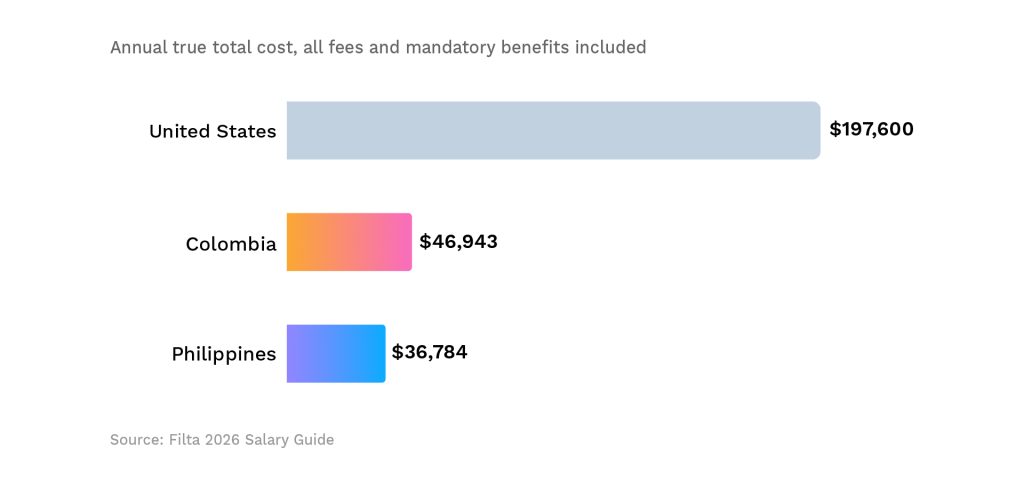
For example, the guide puts the annual True Total Cost for a Digital Marketing Manager at:
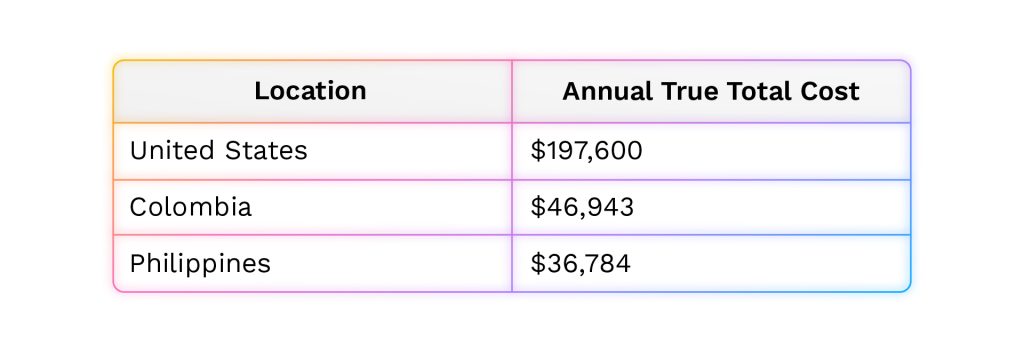
The figures show a substantial cost difference between hiring the same type of role locally in the US and building the role in the Philippines or Colombia.
Filta’s guide also gives a broader team example. A five-person senior team in the Philippines has a calculated True Total Cost of $161,098 per year, compared with $657,800 for the equivalent US team.
That is a difference of $496,702 per year based on the guide’s comparison.
What About the People You Hire?
Cost matters, but the role itself matters too.
An offshore employee can take on the same kind of professional responsibilities as a local employee, depending on the role and their experience. Marketing specialists can manage campaigns. Developers can work on products and systems. Project coordinators can keep teams and deadlines moving.
With Filta’s dedicated team model, professionals work full-time for the client and become part of the business. They can learn the company’s processes, work with internal teams, take ownership of their responsibilities, and contribute ideas as they become more familiar with the organization.
This is one reason the conversation around offshore staffing has moved beyond simple cost savings. Deloitte’s Global Outsourcing Survey identifies access to skills and agility among the factors businesses consider when using outsourcing, alongside cost.
Offshore Staffing in the Philippines or Colombia?
Filta helps businesses build dedicated teams in both the Philippines and Colombia.
The Philippines offers a large professional talent market across areas such as marketing, technology, operations, administration, and customer support.
Colombia can be useful for businesses that need greater overlap or real-time collaboration with US working hours.
The right location depends on the role, the skills required, working hours, and how the team will work with the rest of the business.
Frequently Asked Questions About Offshore Staffing Costs
- How much does an offshore employee cost compared to a local hire?
Filta’s 2026 Salary Guide puts the annual true total cost of a Digital Marketing Manager at $36,784 in the Philippines and $46,943 in Colombia, compared with $197,600 in the United States. - What is included in the true total cost of an offshore employee?
For the Philippines, Filta’s True Total Cost includes annual gross salary, Filta’s management fee, 13th-month pay, government benefits, and private health insurance. - How much can a business save with an offshore team?
A five-person senior team in the Philippines has a calculated true total cost of $161,098 a year, compared with $657,800 for the equivalent US team, a difference of $496,702 a year. - Should I hire offshore staff in the Philippines or Colombia?
The Philippines offers a large talent market across marketing, technology, operations, administration, and customer support. Colombia suits businesses that need real-time collaboration during US working hours. The right choice depends on the role and how the team will work with the rest of the business.
Offshore vs Local Hire: Compare the Full Cost, Not Just the Salary
If you are comparing a local hire with an offshore hire, start with the full cost of employment.
Look at salary, benefits, employer costs, insurance, recruitment, equipment, and any other expenses involved in keeping the role running. Then consider what the person will actually contribute to the business.
Filta’s 2026 Salary Guide provides salary ranges and True Total Cost calculations based on March 2026 market data and live placements across Metro Manila, Cebu, Bogotá, and Medellín.
Explore more insights on global hiring and offshore teams on the Filta blog.
If you are considering building an offshore team, talk to Filta to see what the numbers could look like for your business.








 +61 (07) 2146 2211