
 Let's Talk






The Philippines just declared a national emergency over oil prices. Colombia didn’t even blink. Here’s what that means for your offshore operations – and your next conversation with your CFO.
By Nerissa Chaux | Co-Founder & Chief Growth Officer, Filta
I’m going to be honest with you. We built Filta with the Philippines at its heart. We have deep roots in Manila. Our longest-standing client relationships, our most tenured teams – they’re there. So when I tell you that right now, if you’re building your first offshore team or expanding into a second location, Colombia deserves your serious attention – I’m not saying it lightly.
I’m saying it because the data is clear, and because I’d rather have an uncomfortable conversation with you now than a very costly one later.
What just happened in the Philippines
In late March 2026, the Philippine government declared a state of national emergency over soaring oil prices. That’s not a headline to scroll past. The Philippines imports 98% of its oil – almost all of it from the Gulf. When global oil markets convulse, as they are right now with tensions around the Strait of Hormuz, the Philippines feels it faster and harder than almost anywhere else on earth.
Fuel costs flow through everything. Transport for your team getting to the office. Electricity costs for running that office. The price of food at the canteen. Cost of living for people who are already stretching every peso. This isn’t abstract macroeconomics. This is the lived daily experience of the people who show up and do great work for your business.
“The Philippines declared a national emergency. Colombia didn’t even blink. That difference in economic architecture matters more than most hiring managers realise.”
— NERISSA CHAUX, FILTA
For existing clients with Manila-based teams: your people will be okay. Filta does right by your staff, and we’re watching this closely. But for companies making decisions right now about where to plant their next offshore flag – you need to understand the risk profile difference between these two countries.

Colombia and the Philippines: two very different oil stories
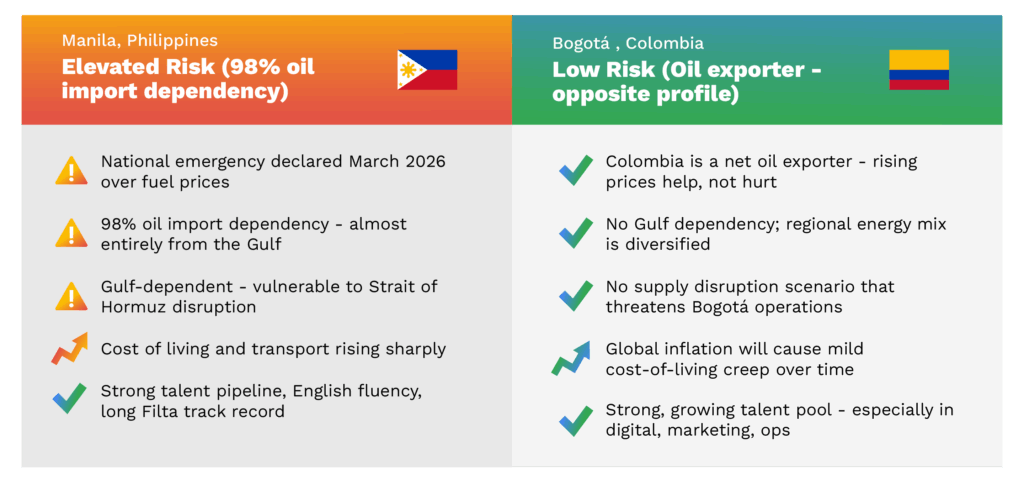
The difference isn’t that the Philippines is failing – it’s not. It’s that Colombia’s economic architecture is fundamentally different when it comes to oil dependency. If the global energy situation escalates further, Bogotá operations have a structural buffer that Manila simply doesn’t have right now.
This is a business continuity conversation, not a betrayal
Here’s something I’ve noticed in my conversations with owners: they sometimes feel guilty even raising the Colombia question. Like they’re abandoning people they care about in the Philippines.
You’re not. Choosing Colombia isn’t a vote against Manila. It’s a vote for smart risk distribution.
The best operators in the world don’t put everything in one geography. They think about supply chain resilience. They think about what happens when a port closes, or a power grid strains, or a government declares an emergency. They spread appropriately. They sleep at night.

And here’s the other thing nobody says loudly enough: Colombia is competitively priced. Particularly for US-based clients operating on EDT, the timezone alignment with Bogotá is almost perfect. You get overlap with your team in real working hours – not a heroic effort by someone who starts at 10pm to match your morning standup.
The savings are real. The timezone works. And right now, the risk profile is as low as it gets.
What I’m telling clients right now
If you already have a team in Manila – protect them. Invest in them. We do. They are extraordinary professionals and the Philippines remains one of the world’s great outsourcing destinations. Nothing about the current situation changes that long-term story.
But if you’re planning your next hire, your next team, your next capability build – and business continuity is on your radar as it should be – then Colombia should be in your evaluation. Not as a backup plan. As a serious first option.

We’ve been building in Bogotá long enough to know what works and what doesn’t. We know the talent. We know the culture fit for our clients. We know how to build teams there that stay – because tenure is everything in offshore work, and we’ve cracked that problem in both markets.
“The clients who will thrive in the next three years aren’t the ones who reacted fastest. They’re the ones who read the room earliest – and built their operations accordingly.”
— NERISSA CHAUX, FILTA
You don’t have to have all the answers right now. But you do have to be asking the right questions.
The right question today is: where does my offshore operation sit on the risk curve and is that where I want to be?
→ Explore more of these insights at filtaglobal.com
→ Connect with Nerissa Chaux via LinkedIn!








 +61 (07) 45180033


