
 Let's Talk






Key Takeaways:
- Offshore and nearshore hiring serve different business needs. Choosing the wrong model for the wrong role creates friction that compounds over time.
- Nearshore means hiring from a country with close geographic and time zone proximity. For US companies, Colombia is the primary nearshore option, operating on the same hours as US East and Central teams.
- Offshore means hiring from a country with a significant time zone difference. For most Western companies, the Philippines is the most established offshore market in the world.
- The decision comes down to three questions: does the role need real-time collaboration, what kind of talent depth the role requires, and what time zone coverage the business needs.
- Filta operates in both markets under one roof, which means businesses can build across the Philippines and Colombia through a single partner, one invoice, one point of contact, one process.
- 70% of international ventures fail not from lack of strategy or skill, but from cultural misalignment, according to Filta’s research. Cross-cultural training on both sides is what prevents this.
- Filta’s three-year retention target, backed by structured engagement programs, applies across both markets.
Bottom line:
Offshore and nearshore are strategic choices, not just geographic ones. The businesses building the most efficient global teams are the ones matching the right market to the right role rather than applying one model to everything.
The terms offshore and nearshore get used interchangeably in a lot of conversations about global hiring. They should not be, because the practical differences between them shape everything from how a team communicates to how it performs over time.
Understanding the distinction is the starting point for making a global hiring decision that actually holds up.
Offshore vs. Nearshore: What Each Model Means
Nearshore staffing means hiring from a country that is geographically and time-zone-adjacent to your own.
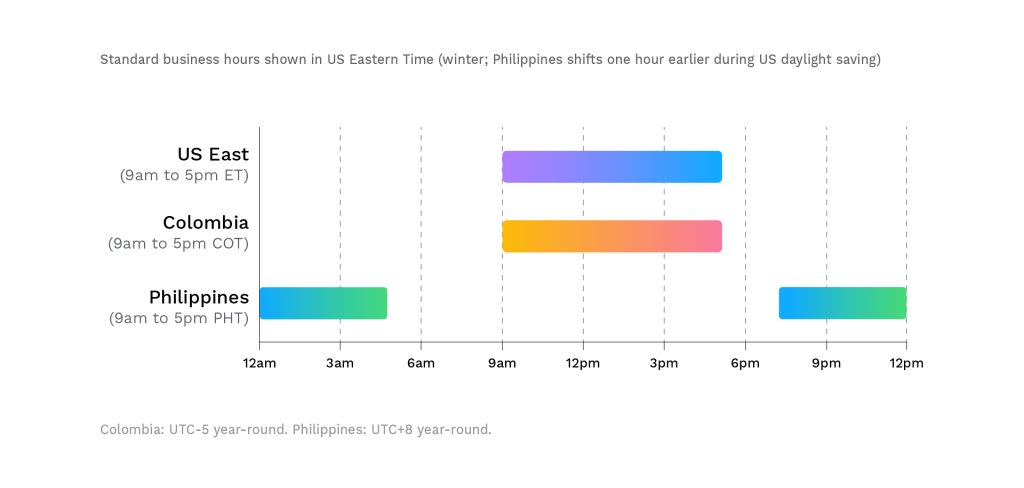
For US companies, that means Latin America. Colombia is the primary nearshore market Filta works in, and the defining advantage is time zone alignment. Colombian professionals in Bogota and Medellin operate on the same working hours as US East and Central teams year-round, with no daylight saving adjustment. The result is real-time collaboration, live standups, same-day feedback loops, and a working rhythm that feels functionally similar to a local hire.
Offshore staffing means hiring from a country with a significant time zone difference.
For Western companies, the Philippines is the most established offshore market in the world. Filta’s Philippine team members work across more than 50 office locations across the country, and the talent pipeline spans creative, digital, finance, operations, customer experience, and technology disciplines that have been developing for over three decades of offshore employment.
The time zone gap with the Philippines, typically 12 to 15 hours ahead of US time zones, means the working relationship is primarily asynchronous. That is not a disadvantage for every role. For some, it is exactly what the business needs.
How to Choose Between Offshore and Nearshore
Before committing to either model, three questions tend to clarify the decision faster than anything else:
- Does this role require real-time responses during my business day?
If the answer is yes, Colombia. Account managers who need to jump on client calls, performance marketers who need to respond to campaign changes within the hour, operations specialists who need to coordinate with the US team live, all of these are stronger fits for a nearshore model where the Colombian hire is online at the same time as everyone else. - How deep does the talent pool need to be?
The Philippines has one of the deepest offshore talent pipelines in the world, particularly for creative, design, video, finance, and administrative functions that have been established there for decades. For roles where Filta needs to find a very specific skill set at volume, the Philippine market typically offers more depth. - What time zone coverage does the business need?
Some businesses benefit from having a team member online after the US team logs off. Customer support, content scheduling, data processing, and overnight production work all run more efficiently when someone is actively working during those hours. The Philippines’ time zone creates a natural follow-the-sun capability that a nearshore team in Colombia cannot replicate.
The Roles That Suit Each Market
Neither market is better in absolute terms. Each is better for specific types of work.
- Colombia works best for: Roles requiring live collaboration with US teams, client-facing functions where responsiveness during business hours matters, real-time project management, performance marketing that needs same-day iteration, account management, and any function where decisions need to be made together rather than handed off asynchronously.
- The Philippines works best for: Creative production, graphic design, video editing, content writing, data analysis, bookkeeping and finance operations, customer support with follow-the-sun coverage, software development, and administrative functions where structured workflows can run independently.
As Filta’s multi-country team page describes it:
Philippines for cost efficiency and deep talent pools. Colombia for time zone alignment and US cultural proximity. That framing is a useful starting filter before getting into role specifics.
Why the Best Answer Is Sometimes Both
A lot of businesses approach this decision as a binary. They pick one market and apply it to every role. The agencies and companies building the most efficient global teams are the ones who use both markets deliberately, matching the model to the role rather than the role to the model.
A US agency might hire a Colombian account coordinator to run client calls in real time, a Philippine graphic designer to handle creative production overnight, and a Philippine data analyst to process campaign reports before the US team starts their day. All three are managed through the same partner, under one invoice, with one point of contact.
Filta’s multi-country model is built specifically for this. Clients who need designers in Manila and account managers in Bogota get both managed as one operation. The compliance, payroll, equipment, and HR support run through a single structure regardless of which market each team member is in.
What Makes Either Model Work Long-Term
The market decision is meaningful, but it is not the primary variable in whether a global team performs over time.
Filta’s research shows that 70% of international ventures fail not from lack of strategy or skill, but from cultural misalignment. That holds whether the team is nearshore or offshore. A Colombian professional who is onboarded without context about how the US leadership team communicates, or a Philippine team member whose manager does not understand indirect communication norms, will disengage regardless of which market they are in.
This is why Filta runs cross-cultural collaboration training for both sides of every placement: the client team and the offshore hire. Communication styles, time zone management expectations, feedback norms, and how to raise problems early are covered before work begins, not after misunderstandings accumulate.
The three-year retention target Filta maintains across both markets reflects what happens when that cultural layer is built in from the start. Filta clients across industries have achieved multi-year team tenure, strong retention, and significant revenue growth by combining the right market choice with the right cultural infrastructure around it.
The full case studies are on Filta’s website.
Frequently Asked Questions: Offshore vs. Nearshore
- What is the difference between offshore and nearshore staffing?
Nearshore staffing means hiring from a country close to your own in geography and time zone, so teams work the same hours. Offshore staffing means hiring from a country with a significant time zone difference, so work is mostly asynchronous. - Is Colombia a nearshore option for US companies?
Yes. Colombia operates on UTC-5 year-round with no daylight saving adjustment, so professionals in Bogota and Medellin work the same hours as US East and Central teams. - Which roles suit an offshore team in the Philippines?
Creative production, graphic design, video editing, content writing, data analysis, bookkeeping and finance operations, customer support with follow-the-sun coverage, software development, and administrative work with structured workflows. - Can I build a team in both the Philippines and Colombia?
Yes. Filta’s multi-country model lets businesses hire in both markets through one partner, with one invoice and one point of contact, while compliance, payroll, equipment, and HR support run through a single structure.
How Filta Helps You Make This Decision
Filta works in both the Philippines and Colombia, which means the market recommendation comes from someone with direct experience in both rather than a preference for one.
The starting point for every client is a conversation about the specific roles, the working rhythm required, and what success looks like in the first 90 days. From there, Filta recommends the right market for each role, recruits in that market directly, and handles EOR compliance, equipment, onboarding, and ongoing HR support through a single engagement.
For businesses that need both markets, that structure scales without adding operational complexity. One partner. Two markets. One team.
If you are working through the offshore vs. nearshore decision for your business and want a clear recommendation for your specific roles, talk to Filta or visit filtaglobal.com to see how the dual-market model works in practice.







 +61 (07) 45180033


